- · Yes, I have been betrayed. An example of when I was betrayed is, it was afternoon after school, and I went down by my friend to chill because I was alone home. While I was down by my friend, I got a phone call from my big sister asking me where I was, I told her that I was by my friend chilling. She ask me if my little sister got home yet, I told her no, she will be home at 3 o’clock so she said ok she will pick her up and go by our house and stay with her. A while after I got a phone call from my mother, I answered with such a sweet tone, all I heard was this, “U gyal how u go lef home u likkle sissa alone, u crazy?” I was so surprised; I didn’t say anything just allowed her to argue. When she was finished, I told her that Sharica, which is my big sister, said that she will stay with DD my little sister. Surprisingly, all that time I was talking to my mother, my big sister was there. She told my mom that she was passing by and she saw DD alone home and she call me and told me and I didn’t come. Being so upset I went home, I reached my house in a minute and it was a five minutes’ walk. When I reach home, the first person to run off their mouth was the witch which is my big sister that’s what I thought of her after she betrayed me. She started cursing and of course I answered. It got so intense that my sister and I started to fight and this fighting was drastic, because mommy started to curse. The funny thing is my grandmother came over and she didn’t know what happen, but she started to blame me, saying “ a Delia nuh, she muss know she a da likkle one, a fu she fault.” All that time the fighting was taking place. My mother got so upset and drag us apart, she literally lift me up and dropped me in the chair. I started to cry because I was upset and I couldn’t get to do what I wanted. My sister started to cry also when my mom was cursing us out. Afterwards, my sister started back on me and we started to curse again. All of a sudden, we heard a police siren. When I looked outside my house, there is my mom with the police. She called my sister and I and told the police to walk with us to teach us a lesson. I started one piece of bawling cause guess what, it was a Friday and I won’t be release till Monday. All the sympathy I showed, in the end my sister and I found out that the police is my mommy’s friend, she called him to scare us, that was a relief. This is story of how I was betrayed.
- · As you read in the story I felt real bad because my sister lied on me and as mentioned above, I cried and fought during the process of being betrayed.
- · Yes I have felt that I was betrayed and at the end the situation was misunderstood. For example, I had a friend an apparently she did something wrong, and a group of people who we hang out with found out and they were talking about it but someone told the friend that I spread the story with her name. So my friend got upset with and started to speak behind my back. Then I started to curse and I said a lot of stuff (J), but in the end I found out that somebody gave her wrong information that’s why she was upset and we apologize and became friends again.
- · Yes the Shakespeare plays that I have studied most of the characters always resort to violence, trickery or evilness. For example in the play, “Much Ado About Nothing” Don John who was known as the antagonists of the play, played a trick to set up two lovers Claudio and Hero, so they won’t get married.
· The Winter's Tale is a play by William Shakespeare, originally published in the First Folio of 1623. Although it was grouped among the comedies, some modern editors have relabeled the play as one of Shakespeare's late romances. Some critics, among them W. W. Lawrence, consider it to be one of Shakespeare's "problem plays", because the first three acts are filled with intense psychological drama, while the last two acts are comedic and supply a happy ending.
Nevertheless, the play has been intermittently popular, revived in productions in various forms and adaptations by some of the leading theatre practitioners in Shakespearean performance history, beginning after a long interval with David Garrick in his adaptation called Florizel and Perdita (first performed in 1754 and published in 1756. The Winter's Tale was revived again in the 19th century, when the third "pastoral" act was widely popular). In the second half of the 20th century The Winter's Tale in its entirety, and drawn largely from the First Folio text, was often performed.
The play's first known performance occurred at the Globe Theatre on May 15, 1611. Scholars have made speculative attempts at a more accurate dating of the play's composition, but such theories have not gained widespread acceptance. What most critics do agree upon is that the style and themes of The Winter's Tale clearly link the play to Shakespeare's other late romances. They conclude that The Winter's Tale is therefore a product of Shakespeare's final period of play writing and that the play was most likely composed after Cymbeline, which is believed to have been written in 1609-10. The primary source for The Winter's Tale is a novel by Robert Green entitled Pandosto; or, The Triumph of Time, which was first published in 1588. The novel was reprinted a number of times after 1607 as Dorastus and Fawnia.
· Elizabethan era was a time associated with Queen Elizabeth I's reign (1558–1603) and is often considered to be the golden age in English history. It was the height of the English Renaissance and saw the flowering of English poetry, music and literature. This was also the time during which Elizabethan theatre flourished, and William Shakespeare and many others composed plays that broke free of England's past style of plays and theatre. It was an age of exploration and expansion abroad, while back at home, the Protestant Reformation became more acceptable to the people, most certainly after the Spanish Armada was repulsed. It was also the end of the period when England was a separate realm before its royal union with Scotland.
The theatre most often associated with William Shakespeare is the The Globe Theatre, which opened in 1599 in Southwark, London. It was the first theatre built by actors, and was roughly circular in shape with an open roof, which led to it's nickname "The Wooden O."
The original Globe burned down in 1613, following an accident with on-stage pyrotechnics, and was rebuilt in 1614. It was finally closed down in 1642, and demolished in 1644 to make way for housing.
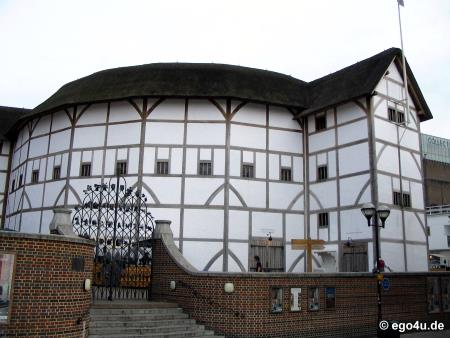 Outside
·
Th Theatre of the Absurd is a theatrical style originating in France in the late 1940's. It relies heavily on existential philosophy, and is a category for plays of absurdist fiction, written by a number of playwrights from the late 1940s to the 1960s, as well as the theatre which has evolved from their work. It expresses the belief that, in a godless universe, human existence has no meaning or purpose and therefore all communication breaks down. Logical construction and argument give way to irrational and illogical speech and as its ultimate conclusion, silence.
http://www.youtube.com/watch?v=v_YSiPorTao – the video

William Shakespeare was baptized on the 26th April,1564 and died on the 26 the April, 1616. His actual birth date remains unknown, but is traditionally observed on 23 April, St George's Day. He was the son of John Shakespeare and Mary Arden; he was the third child of eight and the eldest surviving son. Shakespeare was born and raised in Stratford-upon-Avon in Warwickshire. He was an English poet and playwright, widely regarded as the greatest writer in the English language and the world's pre-eminent dramatist. He is often called England's national poet and the "Bard of Avon".
Although no attendance records for the period survive, most biographers agree that Shakespeare probably was educated at the King's VI New School in Stratford from the age of seven (7) in 1571, about a quarter-mile from his home and he left school at the age of fourteen (14) in 1578. Grammar schools varied in quality during the Elizabethan era, but the curriculum was dictated by law throughout England, and the school would have provided an intensive education in Latin grammar and the classics.
His surviving works, including some collaboration, consist of about 38 plays, 154 sonnets, two long narrative poems, and several other poems. His plays have been translated into every major living language and are performed more often than those of any other playwright artist. Shakespeare was raised in Stratford-upon-Avon. At the age of 18, he married Anne Hathaway, with whom he had three children: Susanna, and twins Hamnet and Judith. Between 1585 and 1592, he began a successful career in London as an actor, writer, and part owner of a playing company called the Lord Chamberlain's Men, later known as the King's Men. He appears to have retired to Stratford around 1613.
In addition, Shakespeare produced most of his known work between 1589 and 1613. His early plays were mainly comedies and histories, genres he raised to the peak of sophistication and artistry by the end of the 16th century. He then wrote mainly tragedies until about 1608, including Hamlet, King Lear, and Macbeth, considered some of the finest works in the English language. Shakespeare also wrote some plays which includes the Merchant of Venice, The Count of Monte Cristo and the Six Tales of Shakespeare etc. In his last phase, he wrote tragicomedies, also known as romances, and collaborated with other playwrights.
According to Answers.com William Shakespeare is known as the best because of his works, especially his plays and sonnets. He is also known for his technique. One cool thing that he did was write in iambic pentameter. Iambic pentameter basically means that each line has 10 syllables. These ten syllables would go in a pattern of stressed, unstressed, stressed, unstressed, and so forth.
Many of his plays were published in editions of varying quality and accuracy during his lifetime.
Shakespeare was a respected poet and playwright in his own day, but his reputation did not rise to its present heights until the 19th century. The Romantics, in particular, acclaimed Shakespeare's genius. In the 20th century, his work was repeatedly adopted and rediscovered by new movements in scholarship and performance. His plays remain highly popular today and are constantly studied, performed and reinterpreted in diverse cultural and political contexts throughout the world.
